The seating chart guide
How to make a wedding seating chart (without losing a weekend)
A seating chart isn't difficult, it's long: a few hundred small decisions, each depending on the one before it. Without an order to work in, it quietly swallows a weekend. Here is the order that works, and what to do about the parts nobody enjoys.
Start with the guest list, not the tables
The temptation is to open a blank floor plan and start dragging. Resist it. The floor plan is the answer; the guest list is the question. You can't decide how many tables you need until you know who is coming, and who can't sit where.
- Name as they'd like it on the card, and whether a plus-one is included.
- Which group they belong to — family, school friends, work, the choir. Sorting them now saves hours later.
- Must-sit-with: couples, parents with small children, the two friends who came together but aren't a couple.
- Must-not-sit-with: the ex, the cousin with the grudge, anyone who'll corner a stranger at the bar. Write these down — you will forget one at eleven at night.
- Anything practical: a wheelchair, a bad back that wants an aisle seat, a hearing aid that wants distance from the speakers.
That list is most of the job; everything after it is arranging. You can paste a guest list into the free planner and it keeps the names in view with a running count of who's still unseated.
How many tables you need
Divide, then add one. 120 guests at tables of eight is 15 tables. That's the arithmetic and a fine place to start — but it isn't a plan, because groups don't divide neatly by eight. The family who won't split across two tables, or the six who came together, leave you with a table of five and a table of eleven.
So count a spare table or two and let it sit half empty. A table with five looks like a mistake; a table with eight looks fine, and nobody counts the empty chairs next door.
Fewer large tables, or more small ones?
Both work. The difference is the evening you get.
- Fewer, larger tables give you more of a room-wide buzz, a tidier look, and an easier fit into a small space. The cost is conversation: at a table of twelve you talk to the four people nearest you.
- More, smaller tables mean everyone can hear the people opposite, with more floor left to walk, serve and dance on. The cost is space, and at the extreme a canteen feel.
Most weddings land on a mix: long tables for groups who all know each other, rounds of eight to ten for everyone else.
Round or long
Rounds put everyone in each other's eyeline, which is why they're the wedding default. Long tables look generous and suit an awkward room, but at a long table you're really talking to the people beside and opposite you; the rest is scenery.
On size: a 60-inch round typically seats eight comfortably, ten at a squeeze; a 72-inch round around ten; a 6ft trestle six to eight. Treat that as a starting point, not gospel — chair width and the space between tables matter as much, and your venue has its own numbers. Ask them.
What actually ruins a table isn't its shape, it's the spacing. Leave room to pull a chair out without hitting the chair behind it.
The order of operations
Seating charts eat weekends because people start with the guests who are hardest to place, then run out of room for the easy ones. Work from the fixed points outwards.
- Lock the table structure. How many tables, seats at each, roughly where they sit. Change this later and every decision after it is void.
- Seat the people who have no choice. The wedding party and their partners, parents and immediate family, anyone who has to be near the door.
- Place the obvious groups — friend groups, colleagues, the cousins who grew up together. These are quick.
- Do the singles and stragglers. The colleague who knows nobody, the great-aunt who isn't close to anyone, the plus-ones who only know their partner.
- Leave the hard cases until last. By now you can see the gaps in the room, which makes those decisions far easier than they are on an empty floor plan.
- Check it, then print it — the last section of this page.
Working this way means you always have somewhere to put someone, and a whole table of people can move in a couple of drags when a plan turns out wrong.
The hard cases
Most charts have three or four guests who jam the whole thing. These are the usual ones.
Divorced parents
Give each of them a table, placed so neither has to walk past the other and both can see the top table. If a table each feels like a public statement, one large table with neutral guests between them works — but only if they're genuinely civil. Decide it in advance and tell the venue coordinator, so nobody is solving it in the doorway.
The friend group that has fractured
Don't seat a split group as though it hasn't split. Two tables, each person on the side they're closer to, someone else's table in between if the break is recent. The group will notice, and mostly be relieved.
The colleague who knows nobody
Put them with people who have a reason to talk to them — your other work friends, or the sociable cousins — not with strangers their own age. One person they already know beats a table of peers, and it's worth mentioning to whoever they'll sit next to.
Children
Small children sit with a parent, ideally somewhere they can get out from without climbing over four people. A children's table works once they can eat and amuse themselves without an adult, which is later than people hope. If you have one, keep it near the door and near an adult who's happy to be the one.
Plus-ones
Next to their partner, not opposite, and not at the far end of a long table with their partner facing away. Resist gathering all your plus-ones at one table — a table of people who know nobody is the loneliest in the room.
The grandparent who needs the door, or a quiet corner
Seat them first, like the top table: near the exit if they'll leave early, away from the speakers if they'll want to talk. Then check the route from the door — no steps, no squeezing between chairs, not through the middle of the dance floor.
Head table or sweetheart table
A head table puts the wedding party in a row facing the room. A sweetheart table seats the two of you alone, with the party at their own tables.
- Head table: traditional, photographs well, gives the party a shared spot. The trade-off is separating them from their partners for the meal, and it's a lot of table to fill if the party is small.
- Sweetheart table: you get a few minutes together on a day that offers none, and the party sits with their own people. The trade-off is being on display as a pair, which some couples find odd after the first course.
There's a third option people forget: a long table for the two of you plus both sets of parents and the officiant. It reads as a top table, keeps the people closest to you in the best seats, and can quietly solve the divorced-parents problem.
How many people per table is too many
There's a simple test, better than any spec sheet. Sit in one seat and imagine talking to the person two places away, across the table. If you'd have to raise your voice or lean past someone's plate, the table is too big.
For most rooms that's eight to ten around a round table. Twelve is where a round table stops being a table and becomes a horseshoe of separate conversations — and ten strangers need to be fewer than ten old friends, because they have to hear each other to become anything else.
Don't number the tables until the end
Numbering feels like the tidy last step, and it should be — it's the only part that's expensive to undo. Once the numbers are on a plan or a card, moving one table means renumbering everything after it and reprinting.
Two more reasons to leave it late. Numbers imply a ranking, and guests read them: table one is where the important people are, table fourteen is Siberia. And tables move while you work — “table three” can be by the door on Tuesday and by the window on Thursday.
So arrange, check, then number. Number outwards from the top table, or in a loop from the entrance, so the numbers follow the room rather than a hierarchy. If a table ends up in the far corner, give it a name or put the loudest group there. In the planner, tables can be renamed at any point.
The final check
Before anything goes to the venue, do these five things.
- Print it. Names that fit on screen turn out too long for a card, and a layout that looked balanced doesn't.
- Count seats against the list. Every seat filled, every guest in exactly one place, nobody quietly left off.
- Look for anyone sitting alone — not just a table to themselves, but nobody they know within two seats.
- Check the venue's layout matches yours: table shapes, the bar, the doors, the dance floor. Your round table may be two trestles on the night.
- Walk it from the entrance. Can older guests reach their seats without crossing the dance floor, and is the buffet route clear of table five?
Hosting Christmas dinner instead? There is a free four-page Christmas table printable — a seating plan, place cards, table numbers and a hosting sheet — on the same paper rules as this one.
Questions people actually ask
When should you start a wedding seating chart?
Once most of your RSVPs are back, usually four to six weeks out. You can sketch a rough version earlier to see how many tables you need, but the real chart wants confirmed numbers — every late reply is a name that has to fit somewhere.
Do you seat couples together at a wedding?
Yes, by default — including plus-ones, who should sit beside their partner rather than opposite. The exceptions are a partner in the wedding party when the top table has no room, and a couple who would rather sit with their own friends. Ask about that one rather than deciding for them.
Should children sit with their parents?
Small children always, and near the door if they are likely to need to leave. A children's table works once they can eat and amuse themselves without a parent, which is older than most people hope. If you have one, put an adult nearby who is happy to be the one.
How do you handle a seating chart with divorced parents?
A table each, placed so neither has to walk past the other and both can see the top table. If they are on good terms, one large table with neutral guests between them can work. Decide in advance and tell the venue coordinator, so nobody is solving it on the day.
Is a seating chart required at a wedding?
No. Smaller, relaxed weddings often run on open seating. It tends to stop working past sixty or so guests: couples split up looking for two seats together, late arrivals end up wherever is left, and the room never quite settles.
Can you make a seating chart in a spreadsheet?
You can, and plenty of people do. The trouble is that a spreadsheet has no room in it — it can tell you table four has eight names, but not that table four is next to the speakers.
Do it somewhere you can see it
The planner is free and needs no sign-up. Paste your list, add your tables, drag people onto seats, and export the chart as an image when it's right.
Open the free plannerWorks on your phone. Your plan stays in your browser.
Prefer paper?
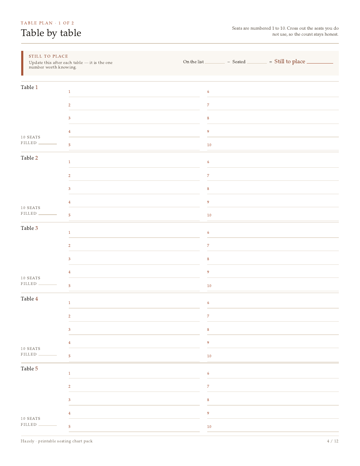
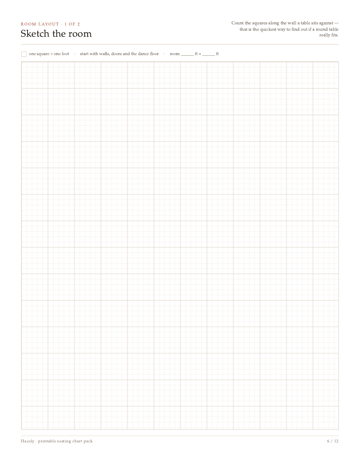
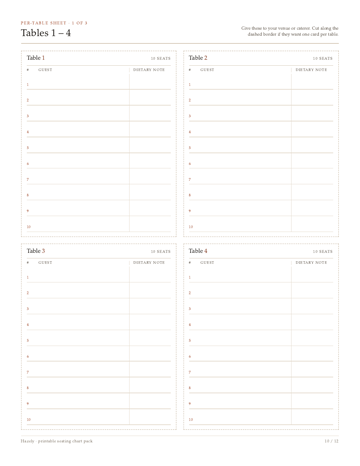
Eighteen pages you print at home, in US Letter and A4. Twelve of them work out the seating: a guest list, a table-by-table plan, a room grid, cut-out tables, and a card for each table. The six after that are for the day itself — a timeline, vendor contacts, a ceremony checklist, a reception checklist, place cards and table numbers.
It costs $9 and sits alongside the free planner: use the screen, the paper, or both.
See all 18 pages — $9